
Digital transformation is moving quickly in healthcare facilities. When it comes to business software and electronic patient records, technologies are developing rapidly, but change still often comes up against one key link: frontline teams. Implementing software in a healthcare facility can quickly turn into an obstacle course. Care staff, general services staff, external service providers… Everyone works with their own constraints and management structure. As a result, the same tool can be adopted within a few weeks by one team and take months to gain traction with another. Discover our tips for successfully driving software adoption in your healthcare facility.
Preparing for software deployment in your healthcare facility
Most digital transformation projects in healthcare are initially approached as technical projects. Choosing the right healthcare facility software, the right tablet, the right interface. But in the field, reality goes beyond one or two features. To successfully drive software adoption in your healthcare facility, you need to think about functionality, but also about people.
Relying on local management
To ensure the successful implementation of software in your healthcare facility, you need stable, hands-on local management.

When frontline managers change regularly, staff are left to deal with the new tool on their own. No one is there to answer their questions on a daily basis, drive the change or reassure them as they adapt to new habits. As a result, software adoption in the healthcare facility slows down. Not because the tool is ineffective, but because no one is supporting its adoption. Conversely, a team supported by present and engaged management can adapt to change within a few weeks. The decisive factor is therefore not the sophistication of the digital solution, but rather the strength of the human ecosystem surrounding it.
This is particularly true when several stakeholders are involved in the same facility: internal teams and external service providers do not have the same management stability, and therefore do not adopt the same tool at the same pace.
Choosing healthcare facility software suited to different user profiles
Beyond management, you need to choose software that suits the wide range of people involved. A healthcare facility never operates in isolation. External service providers, internal teams, rotating management… Each stakeholder adds another link to the communication chain, and each link can potentially slow down deployment.
Teams have their own habits, built around legacy tools that are sometimes not very user-friendly. An interface that is too rigid limits staff autonomy, while one that is too flexible can reduce operational efficiency. Without a minimum level of guidance, any change of tool is perceived as an additional constraint rather than a simplification. This is why it is essential to:
- Define the needs of each type of healthcare facility software user and their level of digital maturity
- Build digital workspaces based on the reality of the job (protocols, job descriptions, route organisation).
- Assess resource-intensive features and deploy them progressively

Gradually scaling up usage
When deploying software in a healthcare facility, no one starts by covering the entire scope at once. It is common to digitise one type of care first before moving on to more complex activities such as inpatient care. This gradual approach should be anticipated from the project design stage, rather than managed urgently once the initial scope has been deployed.
- Define the test teams and those that are most representative of the population within your organisation
- Identify the building, area or hospital department best suited to launching the software in your healthcare facility
- Define the deployment timeline and adjustment milestones
- Correct processes if necessary before extending the software to the entire healthcare facility
Would you like to automate the management of your external service providers?
How can you get frontline teams to adopt healthcare facility software?
Once you have prepared the deployment of your healthcare facility software, you now need to get your teams on board. Faced with these challenges, a method based on four key principles clearly emerges from the field:
Train digital champions and involve managers
Everything comes down to the purpose, added value and usability of your healthcare facility software. If users understand the purpose of the project, see that the tool is intuitive in their daily work and that it frees up time for their core responsibilities, adoption follows. If it is perceived as a constraint, it will be rejected. Buy-in comes from usefulness and ease of use. But all these benefits need to be supported on a daily basis, which is why it is important to train digital champions first.
The digital champion has three key roles:
- they are an ambassador who promotes the project vision
- they are a facilitator who supports their colleagues on a daily basis
- they are a liaison who communicates frontline feedback to improve the tool
With a digital champion, your teams have a direct and responsive point of contact to help them use the software in their healthcare facility. They are essential for answering users’ questions and ensuring that the technology fully meets their operational needs. They are the key to the project’s human success.
Deploy in stages and celebrate small wins
Trying to digitise everything at once is a common mistake. A gradual deployment, starting with a controlled scope, helps secure each stage. Adjustment after adjustment, you build trust with your teams before expanding the scope.
Deployment is therefore not a finish line, but the starting point for a positive dynamic. After launch, the solution is continuously adjusted to embed new habits that make users’ daily work easier over the long term. Schedule weekly or monthly team meetings to gather feedback. This allows you to keep listening to your teams and prevent conflicts before they arise.
Give staff greater autonomy
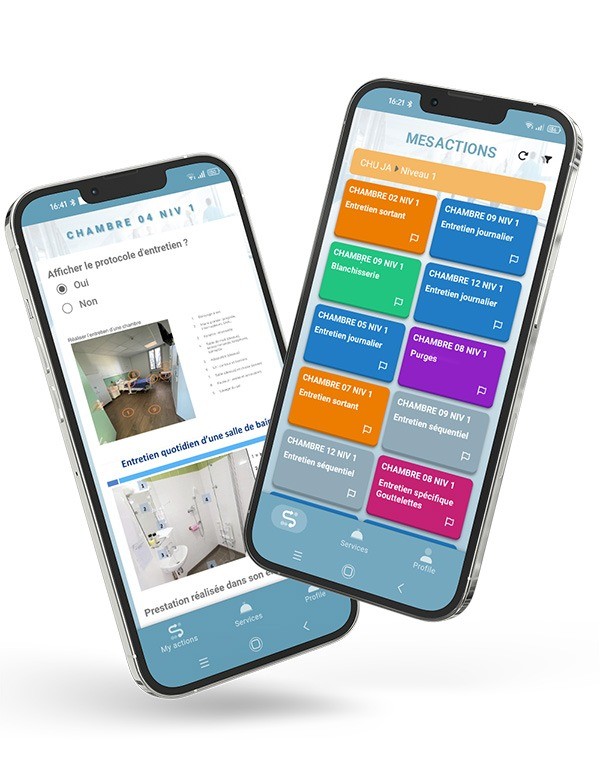
One of the most powerful drivers of adoption for your healthcare facility software is the real autonomy the tool gives staff: direct access to protocols without relying on a manager, the ability to manage certain aspects of their daily organisation themselves (schedules, leave or intervention requests…), communicate with colleagues…
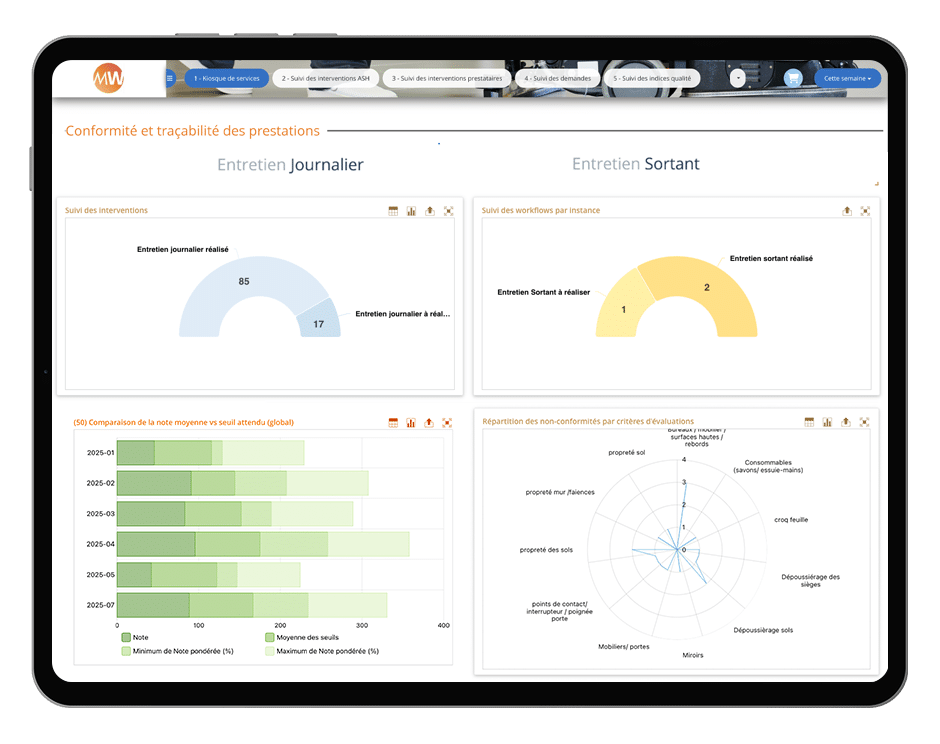
This autonomy must nevertheless remain structured and supported. This is the approach offered by myMissions Indoor, MoveWORK’s hygiene application for sensitive environments. With real-time building mapping, each staff member can view and validate the protocols for their route using an electronic signature. No more dependence on paper or manager approval: everything is centralised through comprehensive automated traceability and real-time non-conformity monitoring.
Get support from an expert consultant
A tool, no matter how well designed, can never replace ongoing human support. A dedicated consultant helps secure the launch phase, train teams in their real working environment, adjust the system based on frontline feedback and, above all, provide support during periods when internal management is unstable or undergoing transition. This is often the factor, more than the technology itself, that makes the difference between adoption within a few weeks and a project that loses momentum.
Three elements are essential: management buy-in, co-construction with frontline teams and user support. Even the best tool will fail if it is implemented without clear direction, without team involvement, or if people are not given a clear understanding of the change through genuine human support.
Aurélie Humbert - MoveWORK deployment consultant
This is why every MoveWORK deployment comes with a dedicated consultant, present from launch and throughout the project. Their role is to understand the customer’s business context, adapt to their functional needs, anticipate potential issues and draw on their experience to propose appropriate solutions.
The best healthcare facility software
Hospital digital transformation now relies on several complementary categories of healthcare facility software:
- Business management software: focused on administration, billing, care management and medical monitoring. These tools often act as ERP systems, but some still have outdated interfaces.
Our recommendation: Gestemic - Traceability and frontline team management solutions, dedicated to the daily organisation of staff (routes, job descriptions, protocols) and task compliance monitoring
Our recommendation: MoveWORK Flow - Internal communication tools, designed to streamline communication between internal teams and external service providers.
- Service and workflow management platforms, which provide real-time intervention monitoring, quality management and dashboards for managing operations and performance. They offer a broader view of operational activities and make it easier to manage both internal teams and external service providers.
Our recommendation: MoveWORK Healthcare
These tools do not replace one another: they address different needs, from medical care to the operational management of frontline teams. It is precisely this last link, often less visible but essential to staff’s daily work, that plays a major role in the success of hospital digital transformation.
How to measure the ROI of healthcare facility software?
A digitalisation project should not be justified by the promise of software, but by measurable figures and tangible benefits. Three indicators can be used to quantify ROI:
- Time saved: less paperwork, fewer back-and-forth exchanges, less time spent looking for a protocol.
- Compliance: fewer non-conformities, fewer disputes with service providers, evidence available at any time for audits, HAS or ARS requirements.
- Decision-making speed: real-time monitoring to correct a deviation before it becomes an incident.